
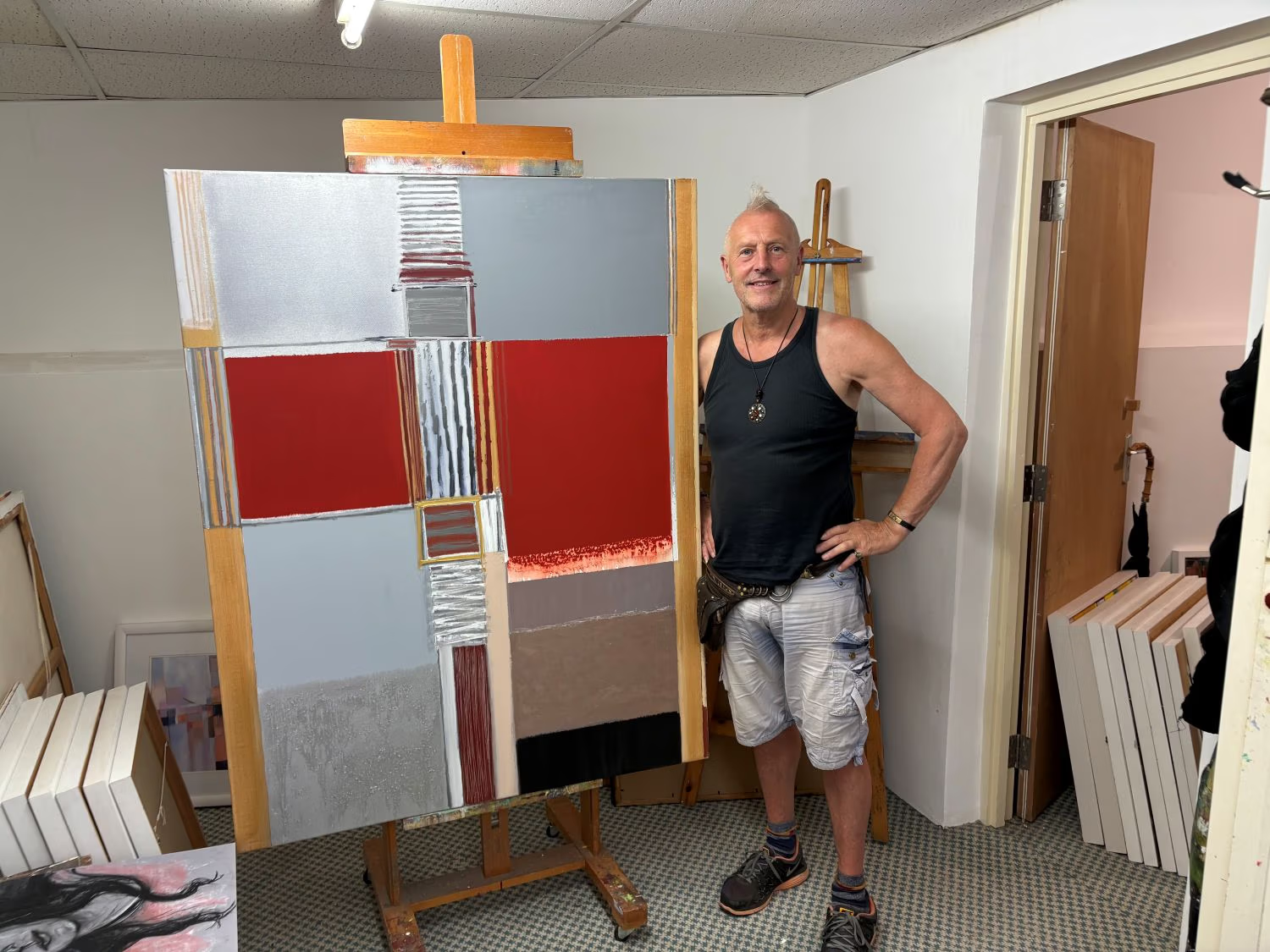
An exhibition of Vincent’s work has taken place recently, at the end of March in the Voyage Art.
About Vincent Rymer

Vincent is an abstract artist who works predominantly on canvas. His work is inspired by a wide, and at times unorthodox range of influences including Picasso, quantum physics, Buddhism and Taoism. His main goal is that his art is not overly constrained – restricted in any way. As he said in his interview. He is also an author.
“Abstract painting is the perfect vehicle or the nearest form to reality to me, because you cannot confine reality just to a viewpoint. You may capture a tree with a gate underneath but there’s a whole world to the left, to the right and behind you.”
In the interview Vincent talks to me about how he became interested in abstract and the influences on his work, his ideas and about some of his paintings and the process that goes into making them.
Starting off
I started off as a figurative artist, so I did years of portraiture and figurative work from life models. I also spent years in the landscape working outside and usually worked from photographs in the studio, developing from realism through impressionism and German expressionism, basically just going through all the ism’s of art and finding my own language.
I studied a degree in Fine Arts, a BA and MA which was part practical, part theoretical. I taught art for 30 years. I was head of an Arts faculty down in Cornwall developing a curriculum that had equal status as Maths, Science and English; one of the first in the country.
I’ve always had a studio space, ranging from a back bedroom to a monumental Dutch Barn. When I lived and taught in Penzance Newlyn I was a member of the Newlyn society also Penwith society of St Ives School of painting. I knew and exhibited with many of the well-known artists e.g.; Patrick Heron, Terry Frost, Wilhelmina Barns-Graham, Sandra Blow, these were all reputable names in British abstract painting.

At that point were you already into abstract?
Yeah I was already moving in that direction in about 1993/94 and the catalyst was reading a statement by Picasso. He said, and this is just a jist:
“If you know where you’re going, don’t go” – Pablo Picasso.
I have greatly simplified this but what I interpreted was if something already exists in reality don’t replicate that, go beyond that perceived reality into a different kind of reality and present something which is maybe more about your feelings as opposed to just what you’re viewing through the eyes. It’s a kind of integration between inside and outside. I effectively went into mindscapes and spent a lot of time just developing ideas from the landscape.
At the same time I was looking at a concept developed by Peter Lanyon another painter from St Ives – Simultaneity. He was a glider pilot and when he used to go up he would look at the landscape from above and then represent that landscape simultaneously as if you’re looking at it from the front from the side and above. Picasso had developed a similar concept years before which became Cubism as we know it.
At the same time for me, I discovered correlations between what was going on in science and the development of quantum physics and I got very interested and studied an MA which involved molecular biology on the one side and quantum physics on the other.
It was all very new to me since I had no science background whatsoever. At this time I’d also been studying Buddhism for nearly 9/10 years. I’d mediated in the Himalayas and been ordained as a Lay monk and I was very much into concepts like, samsara, the cycle of life and death.
I started looking at all these developments in terms of how it expands our consciousness and how that influences how we look at reality. Then I got into things like parallel universes and realising that at any given moment we are going to see what we are creating. There’s a word called simulacra, the idea is that we can create representations of something but it doesn’t have to be exact, it goes beyond that.
All these different concepts came together through my art to represent these different states of consciousness, which had some kind of scientific basis but also had a basis in my own revelations and epiphanies through meditation.
When I heard Picasso’s quote, it completely stopped me in my tracks.
I realised that actually I must go beyond with what I’m trying to represent in the landscapes. I had to develop a whole new set of skills, a whole new vocabulary, and a whole new language which was based predominantly on Abstract Expressionism, arguably the Art scene had moved from Paris via Berlin/Munich to New York USA. I studied absolutely everything I could about abstract expressionism. I developed lots of techniques which were based on the different forms you’d see from Jackson Pollock, Barnet Newman, Willem de Kooning and Mark Rothko.
I had read Kandinsky’s manifesto called, Discerning the Spiritual in Art. I always felt he never achieved his own manifesto but he definitely planted the seeds for the next generation, and I see myself as somebody carrying on its legacy. His genius was recognising that organic and the geometric are in everything, but I wanted to go even past that because for me Kandinsky’s work was never underpinned by specific philosophical concepts. For my own work I coined the title of Conceptual Abstraction, instead of just working within the traditional forms of painting composition.
There was a guy called Clement Greenberg who talked about flat painting which in effect meant that you abandoned the conventional 3D perspective composition.

One thing I took from Kandinsky other than the geometric/organic was that colour can be sound.
I’ve been an amateur musician for some years and increasingly my music is about sound-scaping and the journey.
I was very conscious that colour carries a certain vibration and operated on particular frequencies so once I started to identify the different frequencies, I began to use colour and sound in a simultaneous way. There were times when I would paint as if conducting an orchestra and work with the colours like instruments. I’d say: Oh I’m feeling a bit like that’s a blue sound, something opaque and high pitched. Whereas the complete opposite maybe a brown, which for me makes a heavy, earthy grounded sound.
I’m just trying to picture it. What does it feel like?
It’s like another voice somewhere and you are oblivious to the external world. The only world you inhibit is the world in front of you the colours, the energy generated.
So it’s about expressing the essence of the moment, as well as the wider context?
I’m very aware of what’s gone on before in Art History and if I see something evolve into something I’ve seen before in other artists work my immediate reaction is to destroy it. Even if it’s a good passage I will deconstruct it, because I want to be constantly delving into the unknown. I don’t want to be goal oriented because I feel it inhibits the creativity. For me it has to be an open canvas, it has to be open world. I don’t know where I’m going, it’s all intuition, instinct, supported but unhindered by knowledge, and consciousness beyond the self.
I often wake up out of this trance like state and think how was that bit done? Sometimes I’m painting with my eyes closed or I’ll paint with my left or looking away from the painting, all the time it’s creating a different reality, one that’s not controlled or overly considered, and when I look at it in the cold light of day then I start reconstructing and organising or deconstructing.
Often I’ll purposely destroy something, the death knell of art is in being precious. Because then you’re in a fear mode. You have to go beyond that to be truly free, not be afraid to let go. Am I gonna destroy it? Am I going to ruin it? Am I going to make marks that will wipe out all the beautiful ones? It’s only in this state of fearlessness that you can create something new.
Abstraction is a perfect form as it’s not tied to the image, not slavishly trying to reproduce a representation of 3D reality, it’s a very freeing thing. Frees the mind, frees the way you work, allows for a dialogue with the painting itself and often you are not imposing ego-consciousness with the painting, allowing it to speak back and you get into a dialogue which enables you to move out of the imposition of ego-mind into a receiving space (Like channeling).
It’s a constant exploration. I see myself more and more like an alchemist. Where not only do I use a variety of materials which contain chemical elements, but also involves a wide range of influences in terms of the mediums, in terms of the technique, conception, perceived reality. This is where you enter into a state of heightened consciousness because by removing those safety nets, comfort zones, boxes, you enter into the unknown realm of creativity and I think this is what Picasso was talking about in that quote. I feel now that after such a long time painting I have developed a very eclectic style. I am always on the lookout for new mediums that enable me to evolve the way I work and open up new possibilities.
Discussing a set of his art pieces.
I’m fascinated by how to represent visually, a conglomeration of perceptions/experiences – feelings etc, in effect representing a parallel universe. Often people ask what is it all about, well it’s not about this or that but it’s something birthed through its own evolution, a hybrid and not open to just one interpretation. People will always have a varied response, be it psychological, emotional, intellectual, or it may just be about colour and that be an aesthetic response and that’s important that it has an open ended potential.
So you’re not aiming for anything in particular but just to inspire some response?
Maybe it’s to do with questioning the nature of reality.
When I see something like that I don’t really know what to make of it. There’s the aesthetic quality to it like you said, but then I start looking at the shapes and think it looks maybe like a bus and a road, with a lamp at the top, but at the same time I know that’s my brain making these shapes.

Exactly, it’s the classic thing of order out of apparent chaos and where we are looking for signs and signification to enable understanding.
Yes, the truth is when I look at it, it’s a mystery.
It is a mystery, all of those things you mentioned and none of them. I could call that a semi-circle of a black moon, you could have two aspects of the moon, dark side and light side simultaneously. I’m amazed you’ve spotted this idea here. This central panel is to do with transportation, that’s exactly what it is. It’s a time capsule, and it’s moving, that’s why you’ve got the end of it already appearing as if it’s moved on, so we’re looking at time and space. We’ve got geometrical elements, a rectangle and a square, the circle, the semi-circle, these are the principle forms of our culture. I don’t personally identify with the triangle. I never include it even though it’s about geometry, it doesn’t express what I want. I prefer the softness of a curve or the beautiful containment of four sides.
Mondrian and the Russian Supremacists are artists that have worked with different aspects of geometrical composition. I’m very much into mark making and you could relate some of this to aboriginal/cave paintings with flint and bark scratching into rock. The surface is like a skin, what we can see is the dermis and the epidermis but underneath we know we’ve got a whole system of blood vessels, muscles and organs etc. I scratch into the surface a lot of the time to reveal what’s underneath, the initial workings of the painting, it’s history as I scratch below the surface.
Which bits of this are scratched? The top right?
Yep, this area here too. It’s back to this whole idea of randomness and apparent chaos. When scientists followed the route of chaos theory it was a premature scientific philosophical realisation of how one views certain realities. But now within advancements in contemporary science, to my basic knowledge it was basically theoretical not actual. In other words there is no such thing as chaos, it is just another form of order, as yet un-deciphered.
Within the composition we start to have associations, those associations become representations, like I was talking about the light side of the moon and the dark side, when you see those two semi circles now you might see it all in a new way; the central area as a capsule, transportation, the idea of consciousness advancing, you’ll see it in a different way. When I talk about aboriginal markings and the scratching of the surface that’s adding more potential meaning to the painting.

Already compared to when I first got here, there’s a lot of difference in how I see that, especially with what you’ve told me. And with the scratching, when does that come in? Is it near the end and is it a kind of random urge?
We can use random, or a different word. It’s an impulse. Purely physical, purely a response. Or its, “That’s not working, I need to do something”. “Why is it not working? Maybe the paints just too heavy? Wrong surface? Wrong texture? Wrong tone?” Maybe it’s to agitate?
Any painting involves a journey. Journey involves motion and stillness. So areas where you’ve got flatness, you could call an area of stillness, because there’s literally no movement. There’s no expression of movement. So look at those two geometric shapes, one is a flat area. Could be perceived as a void, and the other area is like static, e.g. electricity. But they’re portrayed together.
To me that looks like raindrops now that I’m looking at it.
Well you can interpret that as raindrops. For me it’s all energy, then you can give it associations in the physical world. Like ice. Sunshine. Wind.

This is what’s interesting about abstract painting, you don’t have to limit yourself to the physical world, you can go beyond to what I call the felt reality. This is where the levels of consciousness come into being, the more you expand your consciousness the more you expand from the 3D world to a 6 or 7D world and beyond.
It’s going beyond how we normally perceive the world. So abstract painting is the perfect vehicle or the nearest form to reality to me, because you cannot confine reality just to a viewpoint. You may capture a tree with a gate underneath but there’s a whole world to the left, to the right and behind it.
What you’re seeing is an artificial representation of reality, and what I feel I’m doing is closer to reality than the perceived reality, e.g. within pictorial art. For me reality that has no absolutes.
This blue here, we could give it landscape terminology and say it’s the sea and this is the sky. This is the horizon and on the horizon is an oil tanker. And beyond it we have the sun and the moon, in the sky. So I could limit the interpretation of this painting by making references to the external world that we all have a common language about. But what I’m doing is saying well turn it upside down, imagine you’re standing on your head. Or that somebody has given you some 3D or 4D glasses.
We limit the way we view the world because of the mind. The mind is the greatest limiter of how we see the world. And most of that limitation comes from our own experiences, our own history, indoctrination, the way we’ve been educated or not educated. This is why for me my purpose through painting through abstraction is to somehow bring us closer to the nature of reality and of ourselves, to those basic questions. Who am I? Where am I going? What is the purpose of life? Or maybe there isn’t one?
I am just curious about that, how long would you say you’ve spent on this painting?
Sometimes I’ve done a painting in literally two hours, but also it will have probably taken, well as many hours as I’ve been on the earth to gather all the ideas and the inspiration for it and just to express it in a way I can say I do not need to add anything more to that. So it’s actually saying, in that moment, all I need to say.
Some paintings I’ve painted over 10 years at least. To many artists that would be an anathema, that you go back to a painting and constantly work on it, but for me and other artists it’s an ongoing process. Because it’s not about a product, I’m not creating a product, so the process is far more important than reaching some goal or finishing point.
I’m always happy to change a painting and let it evolve. When I sell a painting and let it go obviously I can’t do that but within my collection, it’s a continuous evolution, revolutionised by painting itself and by continued explorations and willingness to go beyond that reality which your seeing. This is for me, the beauty and the freedom of it.
Is it ever hard to let go?
No. There’s an inner knowing, where you reach of saying okay that is not perfection, it has not said everything I want for it to say, but it can be part of a series and that’s okay. I’m getting nearer the truth of my revealed reality if you like, and that may change the next week. We live moment to moment and that is a continuous evolution.

On one level you’ve got the primal state. Picasso spent most of his life, going back to that innocent child. He was somebody at the age of 17/18 who could paint like an academia, he was an academic, had amazing drafting skill, bored out of his brain by the time he was 20 and so he was looking for other ways to present reality.
Picasso was one of the rare art genius’ in history, Leonardo Di Vinci would be right there at the top, and in terms of the 20th century Picasso would be without doubt at the head. It’s quite hard to put anybody in the 21st century who is near Kandinsky or Monet or Picasso, there’s very few artists, because it’s very hard, you can’t reinvent the wheels of painting, you’re still working on a flat surface, there’s the seven visual elements so all you’re doing is tweaking, just creating nuances, but those nuances can be quite significance in terms of how I see the world slightly differently. That’s what keeps me going, it’s that inspiration of not knowing. From a western perspective, the void is always represented as empty space but from an eastern perspective it’s seen as full of energy and potential, and that’s how I see it.
That’s energy, that painting’s just sparks, energy, you could call it fire energy, an implosion, quarks, atoms or photons. It’s completely a quantum painting.
And where do you see it going next? If there’s this whole thing of reinventing the wheel do you think there is some definitive last step that will eventually be reached?
It is about illusionism, I’m still working with the idea of illusion. Whether it creates illusion of space or dimension. But life is an illusion. What I would say is my paintings are far nearer to reality than pictured realism, which is perceiving reality in a moment, as it is, in the outside external world. What I’m trying to do is go beyond. Which brings me back to quantum physics, transcendentalism, spirituality, meditation, expanded consciousness, this is what I’m into.
You’ve got these scientific explanations of reality or the universe or the multiverse and then you’ve got the monks interpretation when through meditation they go to an expansive space, which goes way beyond the ego. They’ve gone to some kind of space which is not confined in anyway by boundaries, knowledge or by logic, rationale. You could argue this is the primal state of being, when the child is born this is all they know. For them we all carry the genes of centuries of life, incarnations, reincarnations, nobody knows anything for certain, it’s all just speculation, but when you experience something beyond the 3D, it starts to cultivate this appetite to go further, so no, there’s no end to it. It’s the only guarantee.
Vincent continues to paint from his studio here at Voyage Art in Teignmouth, where his latest work is constantly evolving. Whether you’re already a collector of abstract art or simply curious to discover something different, his paintings offer a fascinating insight into one of Devon’s most original contemporary artists.
If you would like to learn more about Vincent Rymer, enquire about his original paintings, or find out more about his latest book, please contact Voyage Art. We’d be delighted to help and introduce you to one of the gallery’s most thought-provoking artists.